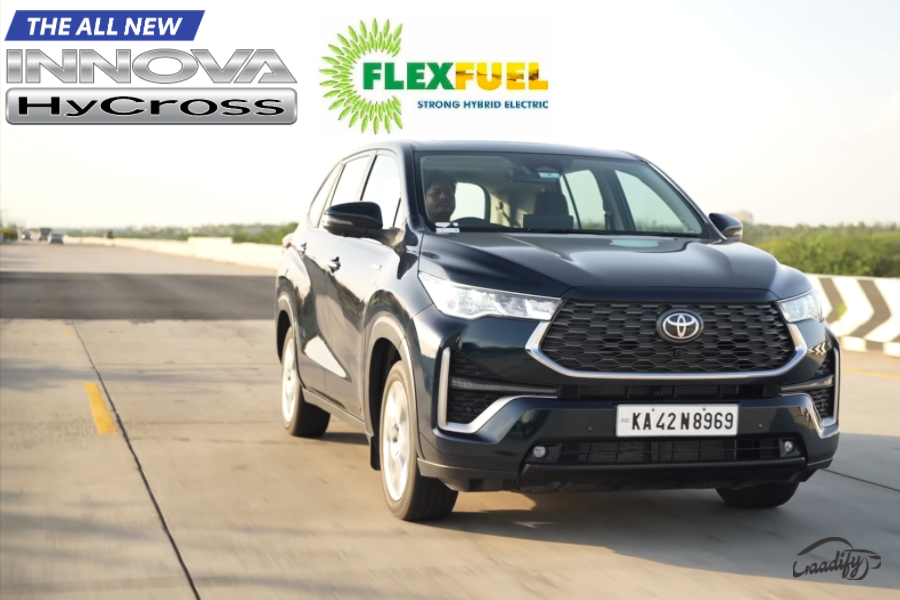
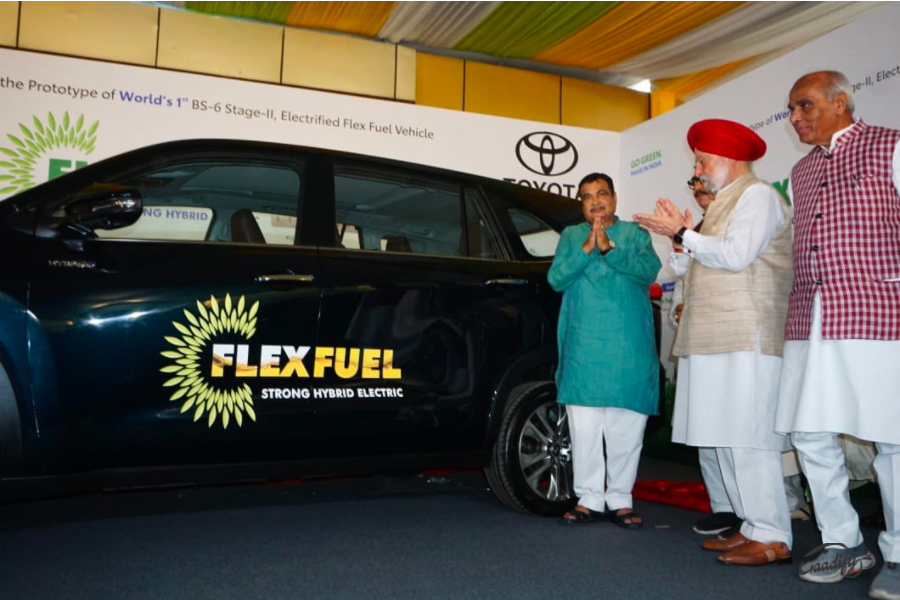
In the presence of Nitin Gadkari, Union Minister of Road Transport and Highways, Toyota India has revealed the BS6 Phase-2 compliant flex fuel strong-hybrid prototype of Innova Hycross MPV, marking Toyota’s stride towards carbon neutrality.
What is a flex-fuel hybrid vehicle?
- Any ICE vehicle capable of running on a blend of different fuels is called a flex-fuel vehicle, and when this type of engine is combined with a strong hybrid system, it is referred to as a flex-fuel hybrid electric vehicle (FFV-SHEV).
Also Read: Nitin Gadkari Introduced New BHARAT NCAP Safety Program
Toyota Innova Hycross Flex-Fuel Hybrid
- In this case, the Innova Hycross is E85 compatible, meaning it can operate on a blend of 85% ethanol and 15% petrol. Typically, in India, the blend is 10 per cent ethanol (E10) in India.
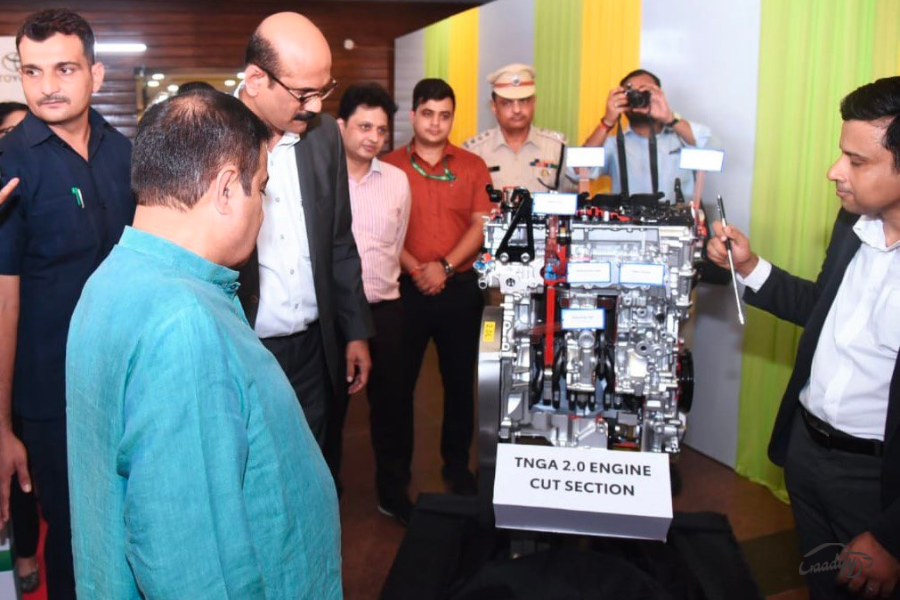
- Under the hood of this Innova Hycross is a flex-fuel-capable 2-litre, 4-cylinder engine coupled with an electric motor and a 1.7kWh battery that’s constantly charged on board.
- This powertrain combination is linked to a CVT gearbox.
- This flex-fuel Innova Hycross is a prototype and will not be launched anytime soon. However, Toyota states that the technology is ready, and if E85 or pure ethanol becomes widely accessible across India, the possibility of introducing a flex-fuel vehicle here becomes feasible.
Benefits of Ethanol Blending/Flex-Fuel
- Flex-fuel serves as an eco-friendly, renewable and more economical substitute to traditional fuels like petrol and diesel.
- It oxygenates the fuel it is mixed with, therefore assisting in preventing air pollution.
- Unlike fossil fuels, it is a renewable energy source.
- The adoption of flex-fuel can aid in decreasing our dependency on oil imports.
- Given that ethanol is derived from crops such as sugarcane molasses, corn, rice, etc., it has the potential to boost the agriculture sector, subsequently fostering employment, particularly in rural regions.
Disadvantages of Ethanol Blending/Flex-Fuel
- Due to the lower energy content in ethanol, flex-fuel vehicles generally offer less fuel economy compared to petrol (depending on the blend percentage).
- Our country has a limited number of ethanol refuelling stations, and the production of ethanol involves emissions and energy consumption.
- The availability of ethanol can also be contingent on the feedstock used for production.
- Ethanol’s carbon reduction potential can differ based on various aspects such as production method and transportation, thus restricting its efficacy as a greener fuel.
- The high demand for ethanol might lead to using the agricultural land that could be used for growing food, which could make food prices increase and affect their availability.
- Vacating land for ethanol crop cultivation can lead to deforestation and habitat destruction, contributing to environmental degradation. Brazil is an example.
- Ethanol crop irrigation requires a high amount of water that could potentially lead to straining local water resources and might end up as water scarcity issues.
- Ethanol crop cultivation also requires a high use of fertilizers and pesticides, which can decrease soil quality and fertility, impacting agriculture productivity in the long term.