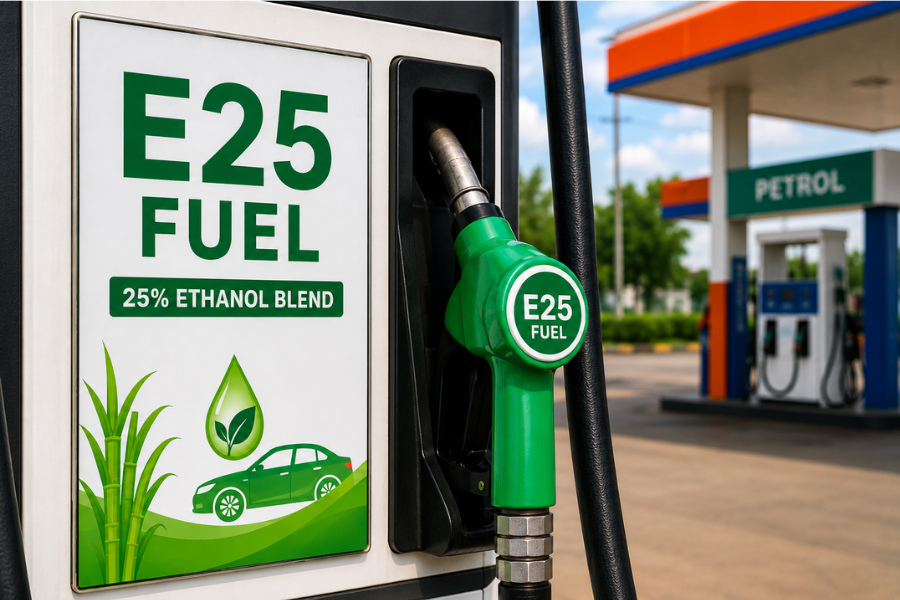
The central government has tasked ARAI to carry out a detailed study on the impact of E25 fuel (25% ethanol-blended petrol) on the performance and maintenance of older E10 and E20-compliant vehicles. This step points out two key things: –
- First, when E20 fuel was previously introduced, it faced significant public outrage regarding its potential impact on older vehicles—an issue the govt likely seeks to avoid this time around.
- Seconds, in an effort to reduce the country’s dependence on crude oil, the government plans to move beyond the current E20 ethanol blend and introduce E25 fuel in the near future.
For those unaware, the Bureau of Indian Standards (BIS) has already set standards and quality parameters for E22, E25, E27 and E30 fuels under IS 19850:2026. The government has also issued draft amendments to recognise E85 and E100 fuels under the Central Motor Vehicles Rules, reflecting the government’s eagerness to even higher ethanol blends.
According to the reports, the ARAI will study and examine the effects of E25 fuel on the mileage, engine health, long-term durability, emissions, and operating costs of E10- and E20-compliant vehicles under real-world conditions. In fact, these vehicles will be tested for roughly 60,000 to 70,000 km for proper assessment.
The report also states that the BIS has indicated that increasing the ethanol blend from the existing 20% to 21% won’t have any significant impact, but moving to 25% blend would require extensive testing to assess its impact on vehicles.
Related: Gaadify Opinion: What Needs To Be Done Before The Roll Out of Higher Ethanol-Blended Fuel
Merits and Demerits of Higher Ethanol Blend
With discussions around high ethanol blend gaining momentum, it becomes essential to understand their advantages, along with several technical, environmental, and economic challenges & drawbacks that cannot be ignored: –
| Advantages of Higher Ethanol Blend | Disadvantages/challenges of Higher Ethanol Blend |
| A higher ethanol blend will reduce our dependence on crude oil imports | Due to ethanol’s low energy density, it impacts the vehicle’s mileage, leading to frequent refuelling compared to petrol |
| Due to its clean-burning nature, it will help lower tailpipe emissions | Concerns regarding material compatibility are serious, as prolonged exposure to higher ethanol blends, which are corrosive in nature, can affect rubber, plastic and engine components in older or non-optimised vehicles |
| Since ethanol is derived from crops, it could also help boost the domestic agriculture sector, particularly sugarcane farmers, thus creating more employment in the rural regions | Issues like cold-start performance, engine calibration and potential long-term wear & tear would need thorough validation |
| Domestic ethanol production will also help lower the skyrocketing fuel prices | Ethanol production in India heavily relies on sugarcane, which is a highly water-intensive crop. An expansion in its cultivation could exert further pressure on already depleting groundwater levels, particularly in water-scarce regions. This could also lead to an imbalance in cropping patterns, as farmers might shift away from essential food crops towards alternative crops. Furthermore, the excessive use of fertilisers and pesticides in sugarcane cultivation can have adverse environmental consequences, such as soil degradation and water pollution. |