A very fundamental aspect of a vehicle which does not find a mention in even the most detailed of conversation is the chassis. But the word fundamental cannot be emphasized enough. The chassis acts as a skeleton to the structure so first things first; there is no structure without the chassis. The benchmark we have currently reached when it comes to structuring, design and strength have all been based on material and mechanical innovations of the chassis.
The chassis is of course very important but at the same time also very indicative. There is a lot you could come to know by analyzing/knowing about the chassis of the product. It shows the class and category of the vehicle and also the price range of the offering.

Through this article, we will be discussing some of the most popular chassis type used in motorcycles.
About chassis and their types
The cost of the mainframe of any motorcycle is highly dependent on the type of chassis in it and also on the type of material which is used for production. Steel has been the traditional choice for chassis material. It is cost-effective and provides reasonable strength and stability for low level and moderate level performance but with the advancement, in material sciences, Aluminium and some alloys now make up the chassis providing lightweight and the required amount of rigidity. More expensive materials have been discovered for the best in class performance motorcycles which make use of Carbon fibre, Magnesium and Titanium.
1. Backbone frame
This is the most basic constituent of the array. This is just a spine-like frame holding on to different parts and not a full-fledged skeleton. The amount of material used is less and the engine is bolted on the spine, so it is not a stressed member.
- Advantages- It is cost-effective and finds its use in the entry-level products which have low power needs.
- Disadvantages- It lacks strength and torsional rigidity.
2. Single cradle frame

It is also called a single down tube frame and is a combination of steel tubes welded together in a pattern which is analogous to that of a bicycle. Thus a motorcycle built on this frame resembles a solidly built bicycle. This is another basic frame and finds applications in products which are built by taking cost in mind. A frame is considered cradled if the engine is a stressed member or in other words, if the engine is cradled in the chassis.
- Advantages- It is a cost-effective and good choice for low power vehicles.
- Disadvantages- Cannot be used in performance-based products, for reasons similar to the backbone frame.
3. Double Cradle frame

This is very similar to the single cradle frame and the only difference lies in the engine support. In the single cradle frame, one steel tube goes underneath the engine and supports it whereas in a double-cradle frame the engine is supported by two tubes, Thus providing better strength and structural rigidity.
- Advantages- This frame is better than the other basic frames and is the strikes the best balance between quality and cost in a price-conscious market.
- Disadvantages- The design is kind of old and outdated and cannot be relied on for a performance-specific product and other higher-cost offerings.
4. Perimeter frame

The perimeter frame or the twin-spar frame is the popular choice when it comes to performance-based motorcycles. Research, based on motorcycle racing found out that there is a noticeable increase in rigidity when the steering hand is connected to swing arm in the shortest possible distance. The rods connecting these should be adequately stiff and results improve with a decrease in weight. Two beams (twin spars) reaching out to the pivot arm surround the engine and that’s where the name twin-spar frame comes from. Earlier these spars were made of steel but lightweight aluminium took its place in the modern world.
- Advantages- This is the most popular choice for performance-based motorcycles.
- Disadvantages- There have been complaints of reduced power in some motorcycles using the perimeter frame when compared to the trellis frame.
5. Trellis frame

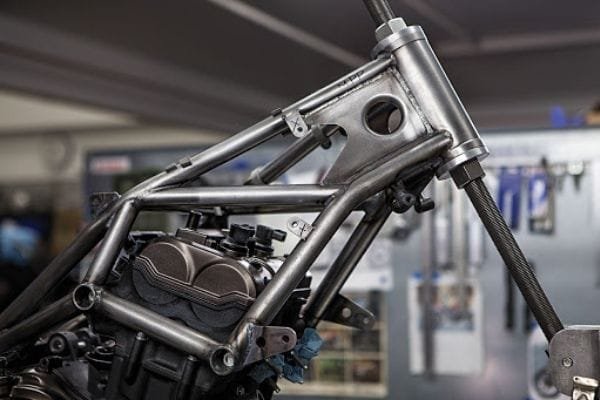
The trellis frameworks on the same principle as the perimeter frame. The primary objective is to connect the steering bar to the swingarm. The difference lies in the way the connectors are constructed. In the trellis frame, steel or aluminium tubes are welded together to form a trellis-like structure.
- Advantages- The trellis frame is lighter and easier to construct and it aces the lightweight construction.
- Disadvantages- It is the best among a huge class of motorcycles, but for most extreme cases, monocoque frame takes the lead.
6. Monocoque frame

The manufacturing of the monocoque frame is the most capital intensive and it needs top-notch robotisation for production. It is not just a viable option for a lot of bike makers out there. This process is employed for the rarest products which come with extremely high power figures. The entire structure, in this case, is a super stiff, single piece with the stiffest and lightest manufacturing materials like carbon fibre and magnesium.
- Advantages- This is made by using the most sophisticated technology out there to bring out the best according to needs.
- Disadvantages- These are too expensive to be viable for a large market proportion.