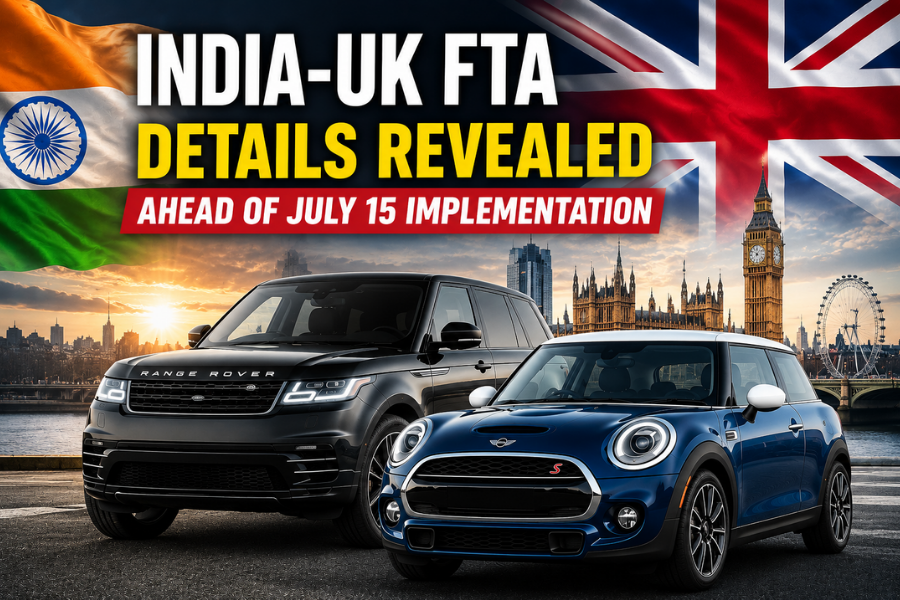
The much-awaited India-UK Free Trade Agreement (FTA) is set to come into force on July 15, 2026, and newly revealed details suggest it could significantly impact the Indian market. From potential reduction in import duties on premium vehicles to increased opportunities for UK-based carmakers, the deal is expected to reshape pricing dynamics and buyers’ choices in the luxury segment. Here’s a closer look at what the India-UK FTA could mean for car buyers and the auto industry in India: –
- The FTA will reduce import duties on British-made vehicles in India to as low as 10% over five years, down from as high as 110% currently.
- This will be done under the quota-based system.
Immediate Price Drop For Luxury Cars
- In the first year of implementation, the import duty on petrol vehicles with engines above 3,000cc and diesel vehicles with engines above 2,500cc will be reduced from the current 110% to 30% for 10,000 eligible vehicles.
- On the other hand, the petrol vehicles with engines between 1500cc and 3000cc, and diesel vehicles with engines of up to 2500cc, will attract 50% duty, down from the current 66%. This will be valid for only 5,000 units for each category.
| Vehicle criteria | New rate | Old rate | Quota Per Year |
| Petrol vehicles above 3,000cc engine | 30 | 110 | 10,000 |
| Diesel vehicles above 2,500cc engine | 30 | 110 | 10,000 |
| Petrol vehicles with engines between 1,500cc and 3,000cc | 50 | 66 | 5,000 |
| Diesel vehicles with up to 2,500cc engine | 50 | 66 | 5,000 |
| Petrol vehicles with up to 1,500cc engine | 50 | 66 | 5,000 |
5-Year Plan
- By the 5th year of this FTA, tariffs across all ICE vehicle categories are scheduled to be reduced to just 10%.
- Annual import quotas will also be expanded to up to 37,000 British-made vehicles under the concessional tariff structure.
- Regular duties will be applied to vehicles imported in excess of these quotas, although it is expected that these tariffs will also gradually decrease over time.
- No tariff concessions will be offered to electric, hybrid and hydrogen-powered vehicles in the first five years of the India-UK FTA’s implementation.
- From the 6th year onwards, alternative-fuel vehicles priced above £40,000 (Rs 49.94 lakh) will be eligible for phased tariff reductions within specified quotas.
Author’s Take
While the India-UK Free Trade Agreement (FTA) promises to open up new opportunities for the Indian automobile market, particularly in the premium and luxury segment, the actual impact will unfold gradually. Although potential duty cuts will make importing luxury vehicles easier, factors like phased implementation, taxation, and brand strategies will ultimately determine the extent of actual benefit to buyers. For now, the deal signals a move towards a more competitive and diverse auto sector in India.
Also Read: 2026 New Mercedes-Benz S-Class Facelift Launched In India