The central government of India has announced exemption of the excise duty on the higher ethanol blended fuels beyond E20, such as E22, E25, E27 and E30. This is actually an extension of the benefit already given to E20 fuel. Though these higher ethanol-concentrated fuels are not available for sale at regular fuel stations, their standards have already been set by the Bureau of Indian Standards (BIS).
Reason Behind The Excise Duty Exemption
Well, the excise duty has been exempted only on the ethanol portion, not on the complete fuel. Let’s understand this in simple terms: –
- Petrol bears excise duty+VAT, and ethanol bears GST at their respective stages. And, when ethanol is blended with petrol, which falls into a manufacturing category, it can again be subjected to excise duty.
- Now, to reduce this complex structure of varied taxes, the government has decided to eliminate the excise duty on the blended fuel to avoid double levy of excise duty on ethanol-blended petrol and keep its prices in check.
Related: Gaadify Opinion – Things Needed To Be Done Before The Introduction of E25/E30 Petrol

Rolled Out Not Anytime Soon
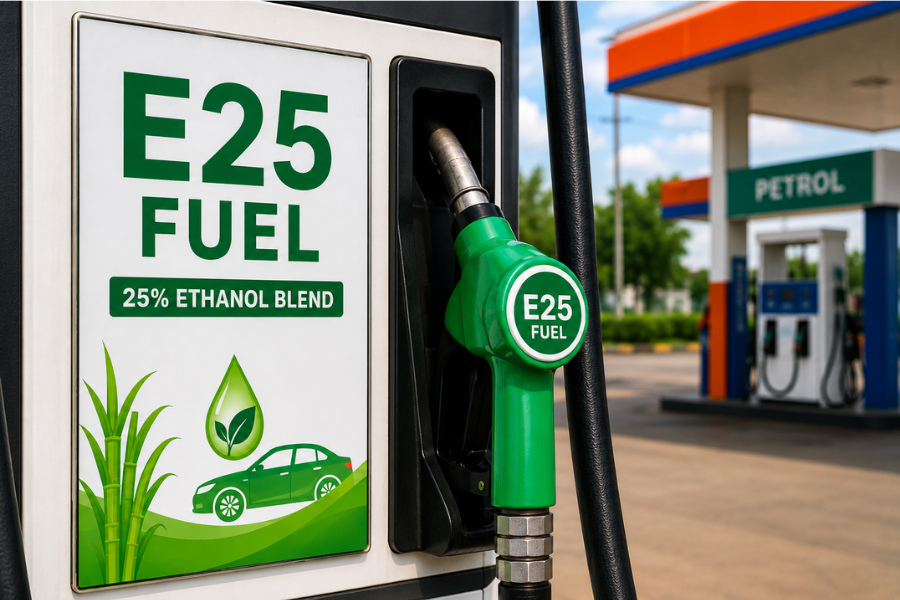
Given the previous public outrage around the E20 blended fuel, the government is playing it safe this time. A few weeks ago, they notified ARAI to conduct thorough research on the impact of E25 fuel on older E10 and E20-compliant vehicles. And now, they have again stated that the rollout of higher blends will only be done after extensive testing and consultation.
Ethanol-blending Stats You Should Know
In its press release, the central government asserted that the aim of the Ethanol Blended Petrol (EBP) Programme is to reduce our dependence on crude oil, save on foreign exchange, related environmental benefits and boost the domestic agriculture sector. The government has also revealed that the ethanol blending by oil marketing companies has been increased from 1.53% in ESY 2014-15 to 20% in ESY 2025-26.
This has resulted in expeditious payment to farmers to the tune of Rs 1.62 lakh crore, foreign exchange savings of more than 1.91 lakh crore, net CO2 reduction of approximately 931 lakh metric tonnes, and crude oil substitutions of about 310 lakh metric tonnes.

Diesel Isobutanol Blending Under Consideration
Aside from increasing ethanol blending in petrol, the government is also considering isobutanol (a type of alcohol-based fuel) blending in diesel to reduce emissions and dependence on fossil fuels. This development is currently in an early stage and may take final shape in the near future.