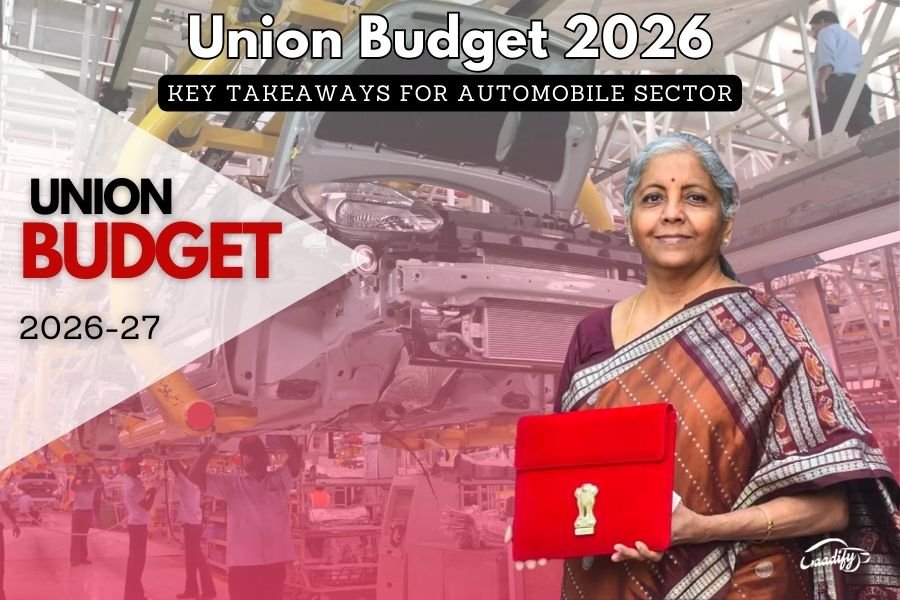
The Union Budget 2026-27 has outlined several key measures that directly impact India’s automobile sector. From policy support for EVs and manufacturing to mineral duty exemptions and excise relief on biogas blends, the latest budget focused on improving cost efficiency and promoting cleaner fuels.
Below are some key highlights from the union budget 202-27 announced by Finance Minister Nirmala Sitharaman that set the tone for how the auto sector could shape up in the coming financial year.
- Relief on Lithium-ion cell production: – The government has announced to extend the duty exemption on capital goods used in lithium-ion cell manufacturing, which will reduce the cost of producing batteries in India. This will encourage manufacturers to locally produce the batteries, which will ultimately make EVs more affordable.


- Import duties cut on key EV minerals: – The Union finance minister has also announced a customs duty exemption on capital goods used for processing crucial minerals used in batteries, such as lithium, cobalt and rare earth elements. This move is expected to lower the cost of local battery manufacturing, improve battery availability and reduce dependence on imports. This will furthermore bring down the overall cost of electric vehicles in the country.
- Excise duty waiver on biogas-blended CNG: – The government has announced full excise duty exemption on the biogas part of the biogas-blended CNG. This means the biogas portion will no longer be counted while calculating excise duty. Earlier, only the GST paid on biogas was adjusted, so some tax was still applied.


- Semiconductor Mission (ISM) 2.0: – Union Minister announced India Semiconductor Mission (ISM) 2.0 to produce semiconductor equipment and materials in India, developing full-stack India chip design, and fortifying supply chains with focus on industry-led research and training centres. This will improve local availability of semiconductor chips, reduce dependence on imports, and help automakers avoid production delays. Additionally, it will also support the shift towards connected, electric and software-defined vehicles.
- Rs 10,000 crore SME growth fund: – Small and mid-size MSMEs like part manufacturers and suppliers to automobile brands will benefit from this announcement to enable capacity expansion, machinery upgrades and quality improvements.
- Rare Earth Corridors to be established: – Dedicated Rare Earth Corridors to be established to support the mineral-rich states of Odisha, Kerala, Andhra Pradesh and Tamil Nadu to promote mining, processing, research and manufacturing. This is expected to ensure a steady domestic supply of rare earth materials for electric motors, batteries and electronics, reduce dependence on imports and lower costs for the automobile and EV industry.
- New Dedicated Freight Corridors to be established connecting Dankuni in the East, to Surat in the West. This will speed up vehicle and auto-component transportation, cut logistics costs, and improve supply chain efficiency for manufacturers across eastern and western India.
Also Read: Mahindra Scorpio N-based Pickup Truck Spied Testing; Interior Revealed