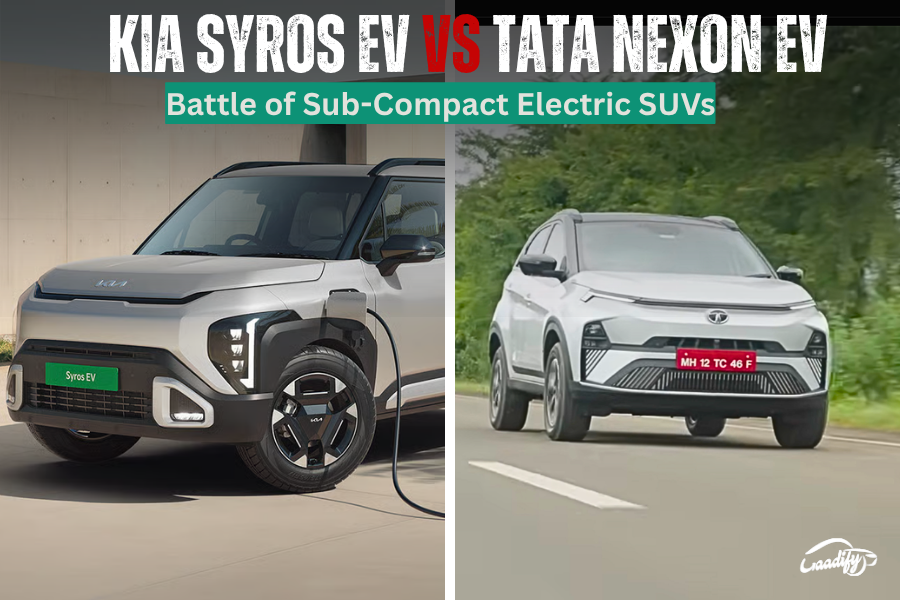
Kia recently unveiled the Syros EV as the brand’s latest and most affordable electric offering, which will be pitted against the Tata Nexon EV, Mahindra XUV 3XO EV and XUV400 EV. Save for the prices, the Korean carmaker has already revealed almost everything about the upcoming compact EV. This might create confusion for some potential buyers about whether they should wait for its price announcement or buy another EV in the segment. So, here we have pitted the Kia Syros EV with the segment leader, the Tata Nexon EV, to help you make an informed decision: –
Kia Syros EV vs Tata Nexon EV: Dimensions
| Parameter | Kia Syros EV | Tata Nexon EV |
| Length | 3995mm | 3995mm |
| Width | 1805mm | 1802mm |
| Height | 1670mm | 1625mm |
| Wheelbase | 2550mm | 2498mm |
| Ground Clearance | – | 205mm (medium range) 190mm (long range) |
| Frunk | 16 litres | – |
| Boot Space | – | 350 litres |
Being sub-4m SUVs, the dimensions of both SUVs are on par with each other. However, the Syros EV boasts 57mm longer wheelbase, which results in more space inside the cabin. And thanks to its sliding & reclinable 2nd row seats, the Syros has more versatile, comfortable and practical rear row for both daily usage and long trips, espiecally for occupants with tall built, allowing them to adjust space and comfort level according to their requirements.


Kia Syros EV vs Tata Nexon EV: Battery, Specs and Charging Time
| Model | Kia Syros EV | Tata Nexon EV | ||
| Battery | 42 kWh | 51.4 kWh | 30 kWh | 45 kWh |
| No of electric motor(s) | 1 | 1 | 1 | 1 |
| Claimed range (MIDC Part 1 + Part 2) | 443 km | 526 km | 275 km | 489 km |
| Max Power | 135 PS | 171 PS | 129PS | 144PS |
| Peak Torque | 255 Nm | 255 Nm | 215Nm | 215Nm |
| DC Fast Charging Time (10-80%) | 39 mins via 100kW charger | 39 mins via 100kW charger | 56 mins via 50kW charger | 40 mins via 60kW charger |
| AC Fast Charging Time (10-100%) | 4 hrs via 11kW charger | 4 hrs 50 min via 11kW charger | 4 hrs 18 min via 7kW charger | 6 hrs 36 min via 7kW charger |
- Both the Syros EV and Nexon EV are being offered with multiple battery pack options.
- The Syros EV’s 51.4kWh unit is the largest battery pack in the segment, claiming a range of 526 km on a single charge. It also offers the highest power & torque outputs.
- The Syros’s standard range comes with 42kWh battery, which is comparable with Nexon’s long-range 45kWh version.
- While the Nexon EV 45kWh claims slightly more range and higher power output than the Syros EV’s 42kWh version, the Korean SUV boasts more torque and supports faster charging which is particualry helpful if you frequently do highway running.
Kia Syros EV vs Tata Nexon EV: Features
| Common | Additional Features In Tata Nexon EV | Additional Features In Kia Syros EV |
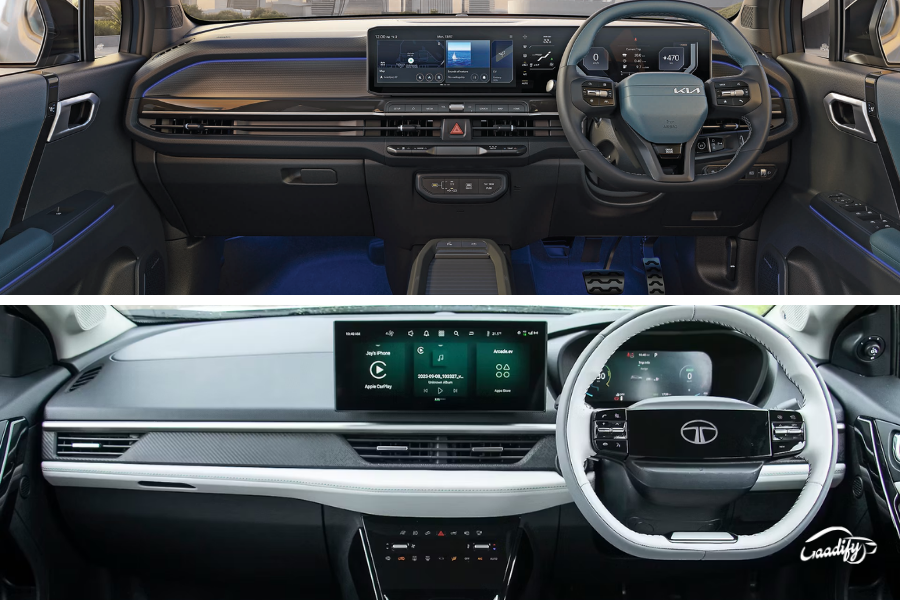
| – Automatic LED projector headlamps – LED DRLs – Alloy wheels – Rain-sensing wipers – Rear wiper & washer – Rear defogger – Panoramic sunroof – Smart keyless entry with push-button start/stop – Multiple driving modes – 12V front power outlet – Height adjustable driver’s seat – Automatic AC – Rear AC vents – Ventilated front seats – Air purifier – Rear sunshades – Power-adjustable side mirrors with auto-fold function – Front & rear centre armrests – Leatherette seats – Paddle shifters for regen braking – Floating touchscreen infotainment system – Digital driver’s display – Wirelesss Apple CarPlay and Android Auto – Connected car technology – OTA updates support – Premium sound system – Steering mounted controls – Ambient lighting – Auto-dimming IRVM – Wireless charger – Type C USB charging port – Vehicle-to-load (V2L) charging support – 60:40 split rear seats – Tyre pressure monitoring system – Electronic parking brakes with auto-hold – ISOFIX child seat anchors – 6 airbags – ABS with EBD – Traction control – Electronic stability control – Hill hold assist – 360-degree camera with blind-spot monitoring – Front & rear parking sensors – Level 2 ADAS suite with auto emergency braking, adaptive cruise control and lane keep assist | – Vehicle-to-vehicle (V2V) charging support – Welcome & Goodbye sequence in front & rear DRLs | – Bigger 17-inch alloy wheels – Auto retractable flush-fitting door handles – Illumination for all power windows – Puddle lamps with Kia logo projection – 64-colour ambient lighting – 4-way powered driver’s seat – Slide & recline function for 2nd row seats – Ventilated rear seats – A dedicated screen for climate control system – 100W Type C port compared to Nexon’s 45W – Side parking sensors – Digital key support – Dual camera dashcam |
Related: 2026 Kia Syros EV All Variants Explained
As is clear from the above table, the Kia Syros EV offer more comfort, convenience and feel-good features over the Nexon EV that will not only enhance overall in-cabin experience but will also adds to its premium appeal.

Author’s Take
Priced between Rs 12.49 – 17.69 lakh (ex-showroom), the Tata Nexon EV is one of the highest-selling electric vehicle in the country. Its success can be attributed to Tata’s early-bird approach, well-equipped cabin, competitive pricing and excellent safety persona, making it a good option for those looking an SUV with low running costs. Now, with the Kia Syros EV in the picture, the Nexon EV is getting a tough fight, at least on papers.
The Syros EV boasts a larger battery pack, longer range, a powerful motor setup and superior comfort-oriented features, positioning it as the most premium offering in the sub-4m SUV segment. However, much like its ICE-counterpart (petrol/diesel version), its design is highly polarising, a crucial factor which deterred buyers, atleast in the case of the ICE version. Now, it will be interesting to see if the electrified Syros can attract buyers with this proven powertrain setup which we have already seen in models like the Kia Carens Clavis EV and Hyundai Creta Electric. Pricing will also play a crucial role to decide its fate in the Indian market.
Also Read: Tata Sierra EV Pure S vs Curvv EV Empowered X: Which SUV Offers Better Value?