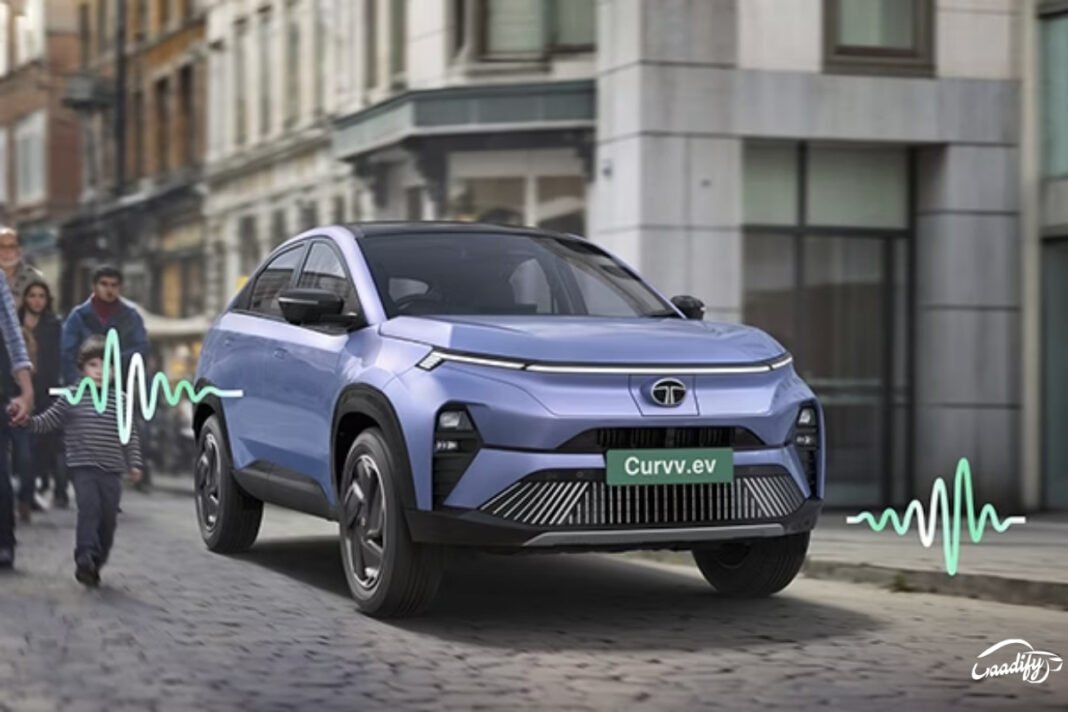
The Ministry of Road Transport and Highways (MoRTH) has issued a draft notification to mandate the Acoustic Vehicle Alerting System (AVAS) for electric vehicles – effective for all new vehicles (categories M and N) from October 2026 and for existing vehicles from October 2027.
The provision specifically does not cover electric two-wheelers, three-wheelers, or e-rickshaws at present.
What is the AVAS System for EVs?
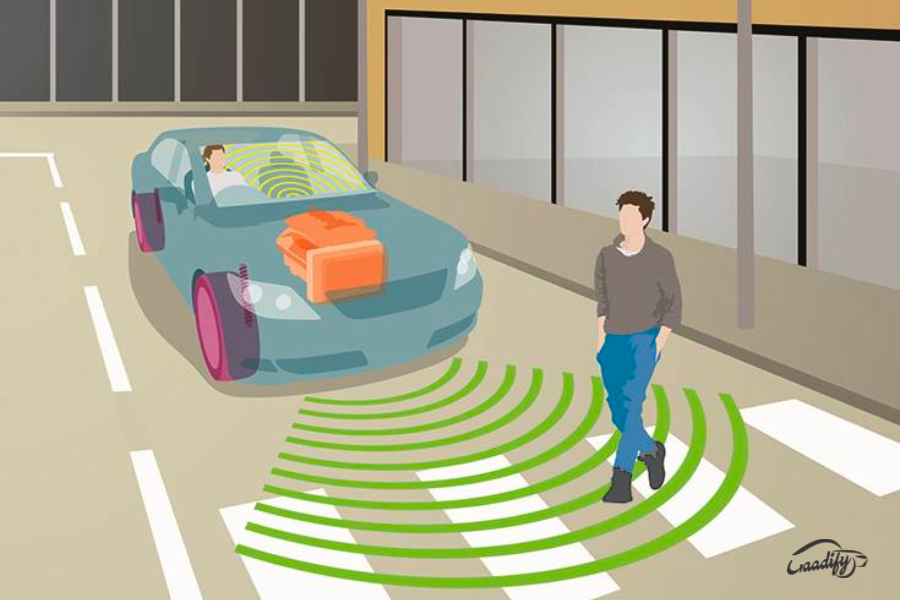
The AVAS system is an onboard sound-emitting system designed to produce artificial noise at speeds below 20 kmph to alert pedestrians, cyclists and visually impaired individuals as EVs are significantly quieter than ICE vehicles (vehicles with combustion engines). Models like the Hyundai Ioniq 5, Creta Electric, Tata Curvv EV, Maruti Grand Vitara Hybrid, Mahindra BE 6, and XEV 9e already come equipped with AVAS.

Why AVAS Is Important?
Studies show that EVs are 37% more likely to be involved in pedestrian accidents at low speeds compared to ICE (internal combustion engine) vehicles (Source: U.S. NHTSA). The European Union, the United States, and Japan have already made AVAS mandatory for all new EVs and hybrids since 2021. According to MoRTH, India had over 2.3 million registered EVs as of early 2025 — a number that’s expected to quadruple by 2030. With this growth, the need for safety mechanisms like AVAS becomes more urgent.
Also Read: Citroen Aircross Excels In Safety with 5-Star Bharat NCAP Rating
Limitations and Challenges
As per the government, the AVAS must meet the audibility standards specified in AIS-173, which is aligned with UN Regulation No 138, similar to AVAS rules in the US, Europe and Japan. While this ensures global harmonisation and simplifies compliance for manufacturers, the current standard may not always be effective in countries like India, where urban roads are typically noisy. In such environments, pedestrians may not distinguish AVAS sounds from ambient noise, potentially reducing its real-world effectiveness.