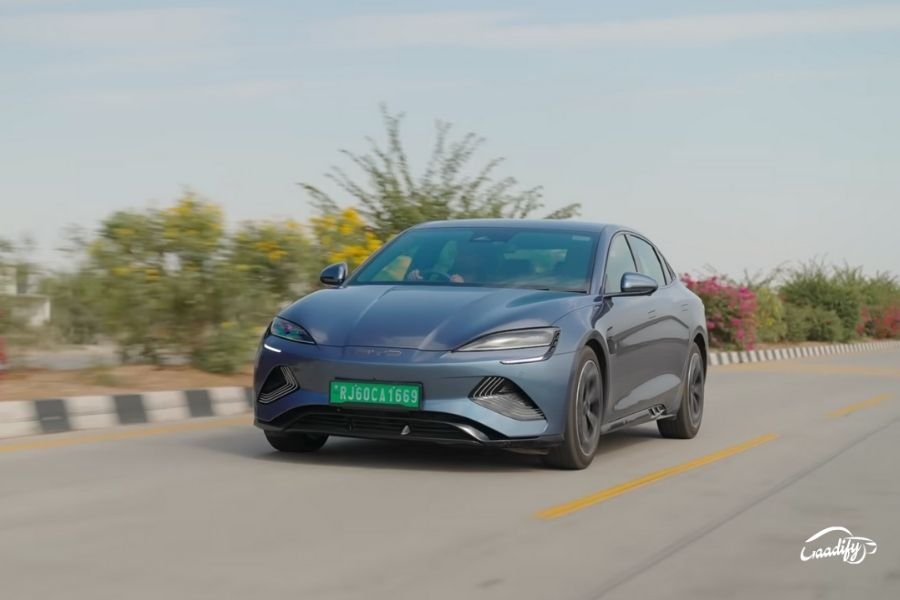
BYD India has issued a voluntary recall of the Seal EV due to a potential issue with the battery pack. The exact recalled units have not been revealed yet.
According to the sources, BYD has requested all the customers of Seal in India, irrespective of their variants and battery size, to get their electric sedan checked by their nearest authorised service centres for a possible fault with their blade battery pack. The service centres will perform an OBD (On-Board Diagnostics) check, and if any issue is found with the Seal’s Blade Battery cells, the brand will replace the entire battery pack free of cost.
Until BYD inspects your vehicles, users are advised not to ignore warning alerts and to report any unusual behaviour immediately.
Also See: BYD Unveils Ultra-Fast EV Charger – As Quick As Petrol Refuelling

About BYD Seal
Priced between Rs 41 – 53.15 lakh (ex-showroom), the BYD Seal comes in three variants (Dynamic, Premium and Performance) and two battery pack options (61.44 kWh and 82.56 kWh), with both rear-wheel and all-wheel drive configurations. Let’s take a look at their specifications: –
| Battery Pack | 61.44 kWh | 82.56 kWh | 82.56 kWh |
| Max Power | 204 PS | 313 PS | 530 PS |
| Peak Torque | 310 Nm | 360 Nm | 670 Nm |
| Claimed Range | 510 km | 650 km | 580 km |
| Drivetrain | Rear-wheel drive (RWD) | Rear-wheel drive (RWD) | All-wheel drive (AWD) |
| Acceleration (0-100 kmph) | 7.5 seconds | 5.9 seconds | 3.8 seconds |
It also boasts rapid charging capabilities of up to 150kW, enabling it to juice up its battery pack from 10% to 80% in just 37 minutes.

Regarding features, it comes loaded up to the brims, with key amenities including 19-inch alloy wheels, flush-fitting door handles, frameless rain-sensing wipers, NFC card key, powered front seats with memory function for driver seat & side mirrors, panoramic glass roof, dual-zone AC, a 15.6-inch rotational touchscreen infotainment, powered sunshade, adaptive suspension with frequency-selective dampers (FSD), 9 airbags, 360-degree camera and ADAS suite.
While it has no direct competitor in the country, it can be seen as a close alternative to the Hyundai IONIQ 5.