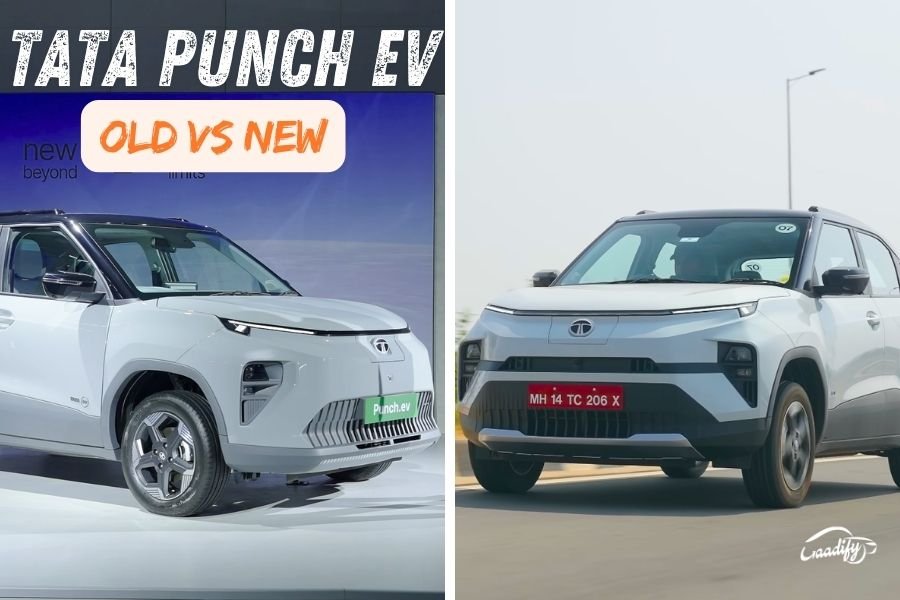
Following market debut in January 2024, the Tata Punch EV has now undergone a mid-life facelift update, receiving subtle styling changes, new features and an upgraded powertrain. Here’s a look at what has changed compared to the pre-facelift model: –

Exterior Design and Dimensions
- At first glance, the new Tata Punch EV looks more premium and sleeker than the outgoing model.
- Upfront, it now gets a more minimal appearance, featuring a curvier bumper with a new textured silver skid plate.
- The low-set vertically-stacked LED headlamp housing has also been revised, and the black cladding that previously connected the headlamps has been removed.
- Additionally, the connected LED strip between the Y-shaped DRLs has also been replaced with new black-finished elements.

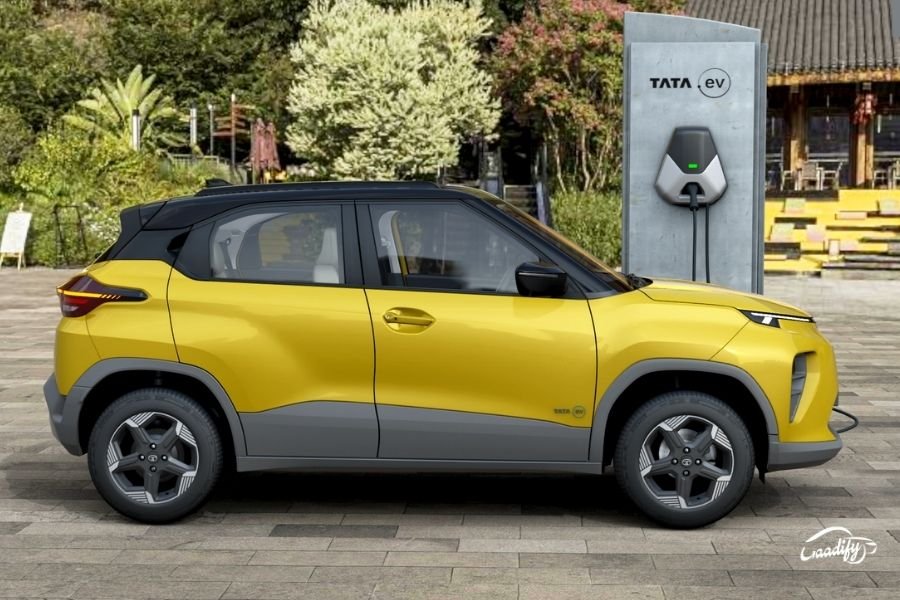
- Not much has changed when viewing from the sides, save for the “Tata.ev” badging on the front doors, replacing the previous “.ev” insignia. Besides, Tata continues to offer it with chunky body cladding and the same C-pillar-mounted rear door handles as the pre-facelift model. However, the cladding is now finished in grey instead of black.
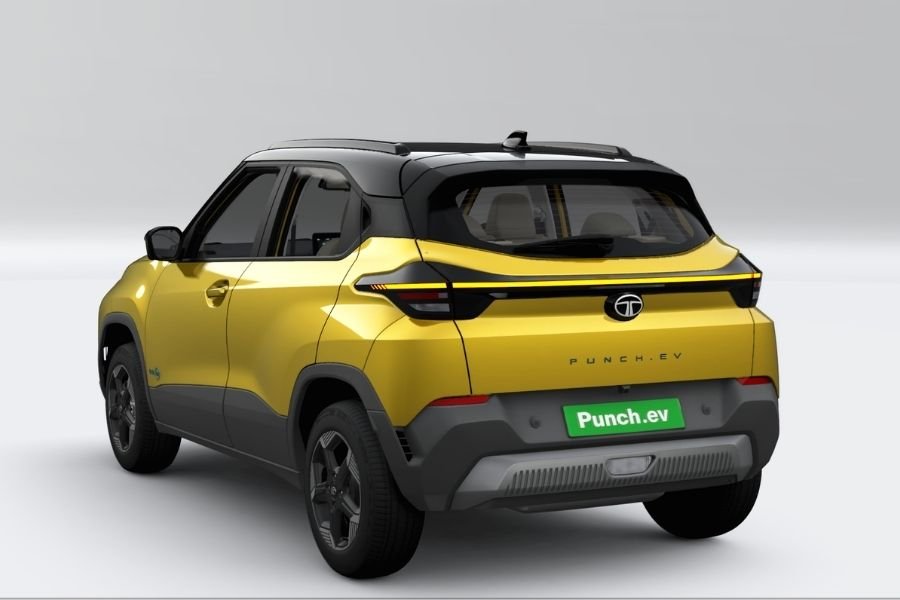

- At the rear, the biggest changes can be seen in the form of a new connected LED tail lamp setup against the small wraparound unit in the previous model with the tri-arrow signature.
- It also gets a redesigned bumper, with a textured silver skid plate.
- Regarding dimensions, the Punch EV continues to be a compact, urban-friendly micro-SUV with SUV-like proportions and practical packaging. However, the ground clearance is now increased by 5mm (195mm), whereas the water wading capacity now stands at 450mm against the earlier ≈ 350mm.
- Its length has also been increased by 23mm, mainly due to the redesigned bumpers. However, wheelbase and boot space remain unchanged.
Colour Options
Tata has added three new shades to the Punch EV’s colour palette, offered alongside the existing four hues. These include: –
- Caramel (NEW)
- Bengal Rouge (NEW)
- Fearless Yellow (NEW)
- Supernova Copper
- Empowered Oxide
- Pure Grey
- Pristine White
Interior
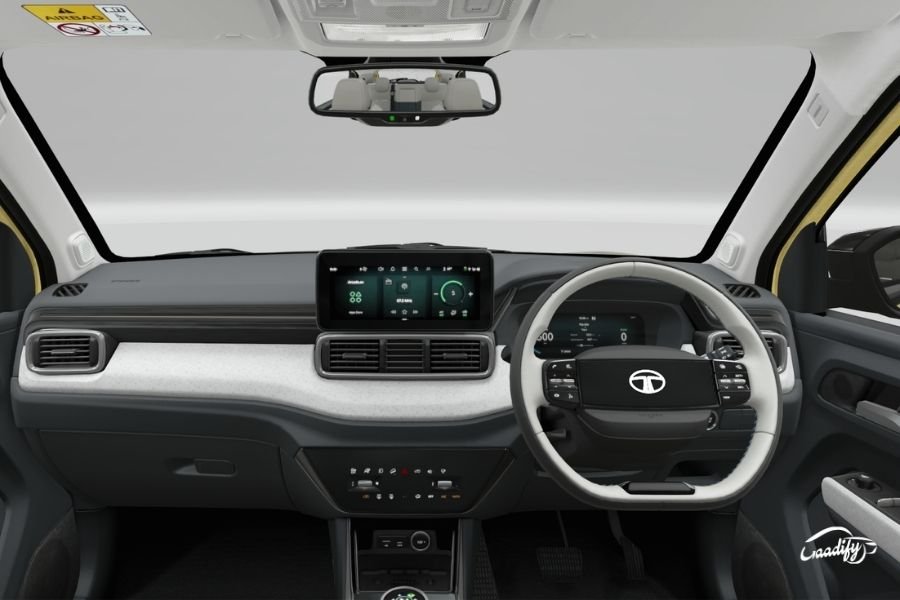

- Inside, the Punch EV facelift remains largely unchanged compared to the earlier model. It continues to feature an upright dashboard layout with a 10.25-inch free-standing infotainment system. However, the updated model introduces a new grey & white cabin theme, replacing the previous black & white colour scheme.
- Tata has also retained key elements such as the two-spoke steering wheel with an illuminated logo and the 10-inch digital instrument cluster from its predecessor.
Features
- In terms of features, the facelifted Punch EV gets an intelligent high-beam assist function as a standard fitment, which automatically prompts a low-beam reminder on the cluster if high beam stays engaged for 60 seconds while driving between 5–40 km/h.
- Tata has also updated the user interface of the infotainment system and driver’s display.
- Besides, it retains amenities like auto headlamps, rain-sensing wipers, wireless Apple CarPlay and Android Auto, Harman Kardon sound system, connected car tech, auto-dimming IRVM, auto AC, rear AC vents, air purifier, keyless entry, USB Type-C fast charging ports, 360-degree camera with blind-spot monitoring, and six airbags from the outgoing model.
Powertrain
- The facelifted Tata Punch EV now comes with larger battery options compared to the earlier model. The previous 25 kWh and 30 kWh battery packs have been replaced with new 30 kWh and 40 kWh units.
- This upgrade directly translates into improved usable range and makes the Punch EV more suitable for longer journeys.
| Parameters | Old Tata Punch EV | New Tata Punch EV | |||
| Battery Options | 25 kWh | 35 kWh | 30 kWh | 40 kWh | |
| Claimed Range | MIDC | 265 km | 365 km | 375 km | 468 km |
| C75 | 190-210 km | 270-290 km | 260-275 km | 335-355 km | |
| Max Power | 81.5 PS | 122 PS | 88.3 PS | 129 PS | |
| Peak Torque | 114 Nm | 190 Nm | 154Nm | ||
| Acceleration (0-100 km/h) | 13.5 sec | 9.5 sec | 13.5 sec | 9 sec | |
- As is clear from the table, the performance of the Punch EV has also improved with the facelift update, thanks to the updated powertrain and battery system.
- Power output has increased from 81.5 PS to 88.3 PS in the smaller battery variant, while the larger battery version now produces 129 PS, up from 122 PS earlier.
- Acceleration has improved as well, with the larger battery variant now completing the 0–100 km/h sprint in just 9 seconds, compared to 9.5 seconds previously.
- Aside from the new battery packs, the updated Punch also gets new 6-in-1 e-Drive system, which integrates multiple components into a single compact unit. This results in 50 per cent more compact packaging, 28 per cent lower weight, and up to 6 per cent better overall efficiency.
- The facelift also introduces an electronically controlled thermal expansion valve (eTXV), which improves thermal management by precisely regulating battery temperature. This enhances efficiency, reduces energy loss, and helps maintain consistent performance.
- Charging performance has improved as well, with the Punch EV now capable of charging from 20 to 80 per cent in just 26 minutes using a 65 kW DC fast charger.
- Together, these upgrades improve energy efficiency, thermal stability, battery longevity, and overall driving smoothness.
Also Read: Maruti eVitara vs Hyundai Creta Electric: Which SUV Makes More Sense?
Price
| Parameters | Old Punch EV | New Punch EV | |||
| Price Range | Pre-facelift Price: Rs 9.99 lakh and Rs 14.44 lakh (At launch in January 2024, prices ranged from Rs 10.99 lakh to Rs 14.49 lakh) | Rs 9.69 lakh and Rs 12.59 lakh BaaS starts at Rs 6.49 Lakh + Rs 2.6/km |
The biggest surprise with the facelifted Tata Punch EV is its pricing. At launch in January 2024, it was priced between ₹10.99 lakh and ₹14.49 lakh, while the later pre-facelift range stood at ₹9.99 lakh to ₹14.44 lakh. Now, the updated model is priced between ₹9.69 lakh and ₹12.59 lakh — significantly lower than its original launch price, despite offering bigger battery packs, more power, improved range, and new technology.
Tata has also introduced a Battery-as-a-Service (BaaS) option starting at ₹6.49 lakh plus ₹2.6 per km, substantially lowering the upfront cost of ownership.