If you’ve ever driven during nighttime, you would’ve definitely come across a couple of other drivers just blaring on high beams for no reason. Although it is very much illegal to drive with high beams on if there are other drivers in front of you or approaching you from the other lane as the light glare can very easily obstruct your vision and throw you off while driving which can be extremely fatal in some cases, it is not enforced strongly so all we can hope and rely on is the goodwill of the driver…. well not entirely though. Thankfully for those of us who are looking to avoid this incessant use of high beams, day/night IRVM is a solid solution.
There are basically two types of day-night IRVM:
- Manual
- Auto-Dimming
Manual Dimming Day/Night IRVM
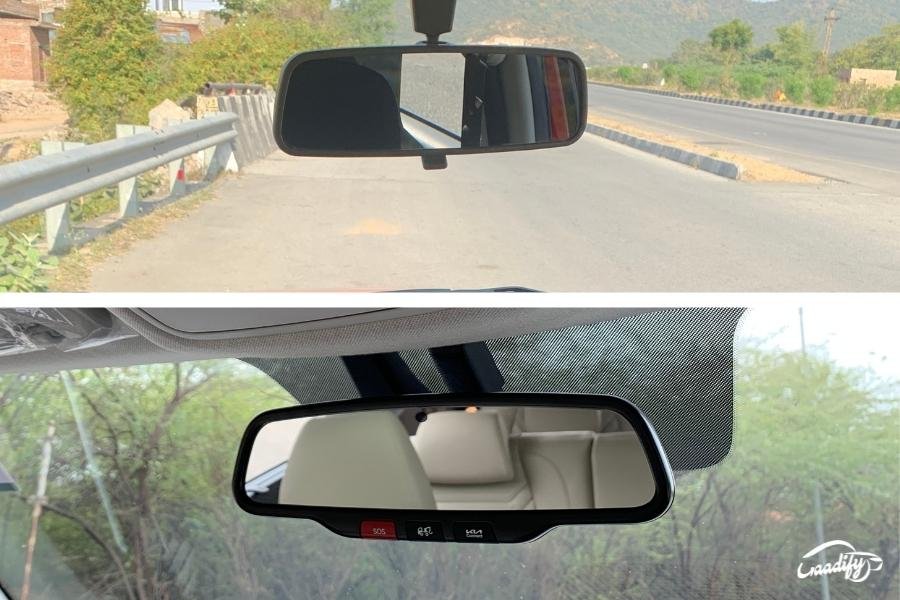
Today, most cars come equipped with manual dimming inside the rearview mirror (IRVM). It is a normal-looking mirror with a little flap on the bottom to switch between bright and dim modes.
How does it work?
In manual dimming mirrors, there are two different types of reflective surfaces. There is a flap at the bottom of the mirror housing, which is used to switch between dim and normal configurations. Whenever light falls on the mirror and the glare is causing distortions to your vision, you can push the flap to switch to the second reflective surface, which reflects the light at a different angle so it does not fall onto your eyes at maximum brightness.
Also Read: Top 5 Most Affordable 4×4 / AWD Cars Available In India
Auto-Dimming Day/Night IRVM (Electrochromic Mirror)
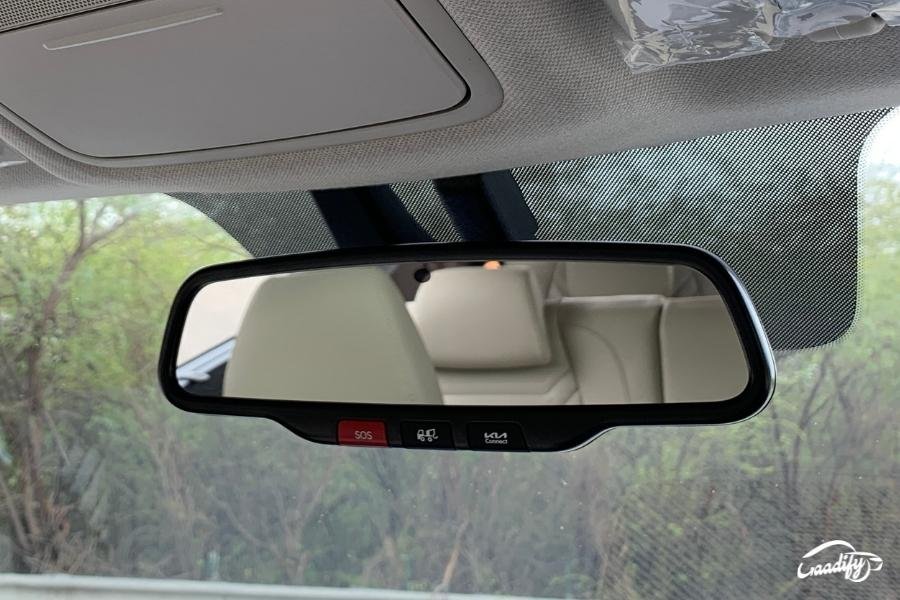
It is also known as an electrochromic mirror. Unlike the conventional day/night IRVM, auto-dimming mirrors consist of an ambient light sensor, two different mirrors with an electrochromic material sandwiched between them, and a microcontroller that handles all the work of sending signals.
Also Read: Honda City’s New e:HEV Powertrain Explained
How Does it work?
The working of the auto-dimming mirror is no rocket science but instead quite fascinating. When the light from the headlight falls onto the ambient light sensor (which is basically a photo-sensitive material that can detect the intensity of light), it determines the intensity of light and sends an electric voltage to the electrochromic substance through a microcontroller.
An electrochromic substance is nothing but a chemical material that can change its color when an electric field or current is applied to it, and that effect is reversible once the current is removed. This material is why auto-dimming mirrors are also called electrochromic mirrors.
Now coming back to the working, as we now know that electrochromic materials possess the ability to change color when current is passed through them, therefore when the microcontroller sends electric current to the electrochromic substance based on the intensity of light measured, the substance darkens itself thereby dimming the mirror and reducing glare. Once the light sensor detects that the light intensity has reduced, it tells the microcontroller to reduce the current which it applies to the electrochromic material which therefore decreases the dimness of the mirror.
Also Read: Cars With 6 Airbags Under Rs 15 lakhs In India
One main disadvantage of auto-dimming day/night IRVM is that they require power to function, and therefore cannot be bolted on like a manual dimming mirror. But auto-dimming mirrors offer more functionality options due to them being powered. For eg: How Hyundai and Kia cars implement their connected car systems and SOS functionality right into the IRVM.