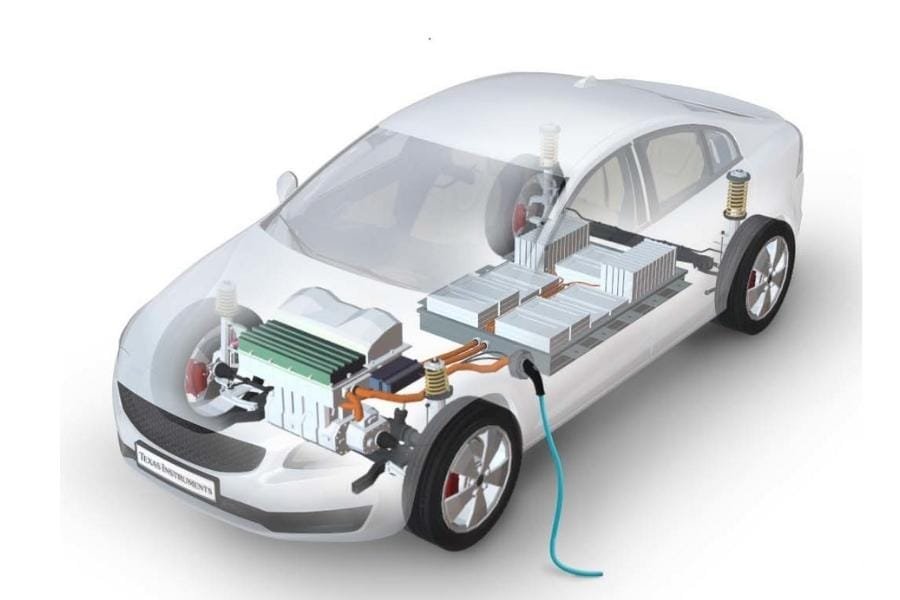
Battery Management System (BMS), as the name suggests, is the brain of a battery pack that monitors and manages it to maintain its optimal functionality. It is one of the most critical components of electric vehicles (EVs) that estimates the State of Charge (SoC) and SoH (State of Health) and provides Thermal Management. In simple words, the BMS is responsible for performance optimization. It regulates the battery’s internal operational parameters such as temperature, cell voltage, total voltage, minimum & maximum voltage, and current during the charging and discharging of the battery to enhance battery performance and safety.
How Battery Management System (BMS) works?
A Battery Management System (BMS) comprises cut-off FETs, a fuel gauge/charge monitor (to track the charge entering and leaving the battery pack), temperature sensors, cell voltage sensors, and building blocks. It constantly monitors the current and voltage and temperature of the battery and its cells. Data from this process is utilized to calculate the charging & discharging rate, energy used, and battery life cycle.
The BMS maintains a constant voltage across all cells through Active or Passive balancing. In passive cell balancing, the bypass resistors/regulators discharge the excess voltage and equalize it with other cells. In Active Cell Balancing, the excess energy of one cell is transferred to other cells with lower values. It uses charge storing capacitors and inductors.
The BMS also communicates with the charger to limit the current discharge as per the battery’s requirement. This way, it also maintains the optimal temperature to ensure longer life of cells. And, when in use, it articulates with the motor controller to keep the battery voltage from falling too low.
Also Read: Top 5 Pros and Cons Of Buying An EV
Benefits of Battery Management System (BMS)
- Assure reliable battery operations.
- Indicates state of charge of the battery.
- Improves efficiency of the battery pack.
- Constantly monitors battery health to avoid eruption.
- Avoids over-charging and over-discharging of the battery pack to extend the battery life.
- Boosts the life span of the battery.