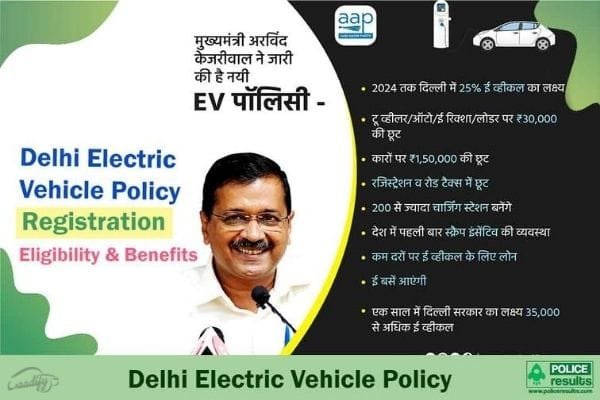
Arvind Kejriwal led Delhi government has recently announced the new electric vehicle policy for the capital. The redesigned EV policy, according to the government’s claims aim to reduce air pollution and give the suffering economy a kick start by creating demand.
The Chief Minister of Delhi addressed a digital press conference to announce the rejuvenated EV policy, and by the first looks, the policy has included some interesting provisions.

Things to note about the new electric vehicle policy
- The policy will be in action for three years and will be revised after that.
- Goal: The aim is to raise the number of electric vehicles in Delhi to 25% of all vehicles by 2024.
- Focus on boosting the volume of electric vehicles in the city traffic with stressed emphasis on replacing conventionally fueled vehicles by electric two-wheelers, shared transport (three-wheeler/buses), goods, carrier and freight.
- The target is to 500,000 new electric vehicles in Delhi in the next five years.
- The notified changes are estimated to avoid approximately Rs 6,000 crores spent on crude oil and natural gas imports.
- Aims to reduce the emission of environment harming CO2 by 4.8 million tonnes and 159 tonnes of Particulate Matter 2.5.
Specialized provision and subsidies announced
The subsidies announcements made in the new policy are applicable for both fixed battery models and swappable battery models irrespective of the vehicle category
Another important thing worth noting is that Road Tax and registration fees are waived off for electric vehicles across all the categories.
1. Two-wheelers
The government has decided to provide a purchase incentive of Rs 5k per kWh of the battery of vehicle subject to a maximum incentive amount of Rs 30k per vehicle. The new electric vehicle will also allow for a scrapping incentive upto Rs 5,000.

2. Four-wheelers
Purchase incentive of Rs 10,000 per kWh battery capacity of the vehicle subjected to a maximum ceiling amount of Rs 1,50,000 per vehicle, for the first thousand four-wheelers sold.
3. Commercial two-wheelers
Two-wheeler taxi services have been given a green signal to include the electric two-wheelers, provided that the guiding compliances are fulfilled. Commercial two-wheelers that are meant to operate in smaller distances (one-mile radius) are expected to be replaced by electric two-wheelers completely by March 31, 2025.

4. Electric Autos/Rickshaws/Carriers
Purchase incentive to increase to Rs 30,000 per vehicle (up from none at present). An open permit system to be in operation for the e-autos, subvention of 5% on the loan or hire purchase schemes for an e-rickshaw

5. Buses
Electric buses will constitute at least half of all the new buses to be added for city bus services. The Government is planning kick-start the electrification of public buses with the introduction of 1000 new buses by the end of 2020.
Charging Infrastructure
One of the most critical aspects for the sustainability of electricity-driven traffic is the charging infrastructure. There is no denying the fact that countries are eyeing the electrification of the majority of its traffic in the coming years and have also started working on the same.
It has hampered the progress and has given the engineers some real trouble due to space and capital constraints, keeping the same in mind, Delhi government has included different provisions for boosting up the charging infrastructure.
The administration projects on setting up 200 EV charging stations in the capital over the next year.

Private Charging Infrastructure
Government has announced a provision to provide 100% subsidy on the purchase of charging equipment. This allowance is subject to the maximum amount of Rs 6,000 for a charging point and can be availed for the installation of first 30,000 charging points at home/workplaces.
Public charging infrastructure
The government aims to provide easily accessible public charging/ battery swapping facilities within 3 km travel radius. Government to provide capital subsidy for the installation of chargers open to public use.
Current numbers
To put the numbers into perspective and portray a clear picture of the tall feat that Delhi government aims to concur, let us get the numbers straight, out of the total of around 11 million vehicles registered in the city, only 83,000 happen to be powered by electricity, which roughly resolves out to be around 0.7%.
Even the majority of the current electric vehicles in Delhi is dominated by e-rickshaws which at 75,500, truly dominates, the population of battery-operated vehicles in the capital city,e-two wheelers and four wheelers are distant second and third with total registration numbers of 3,700 and 900 respectively.
The major couple of problems that have hindered the growth of numbers in which these EV sells are high cost of purchase and non-existent public charging infrastructure. Gladly, the new electric vehicle policy has included provisions to address both of the major underlying issues.

What did the chief minister say?
Delhi CM Arvind Kejriwal was all praise for the step taken by the government and went unto assert that it is one of the better electric vehicle policy on the global scale-
It is believed worldwide that China has a really good electric vehicle system in place. But, now I am sure that when discussions on electric vehicles will be held across the world after five years, Delhi will be leading the way in this field. I am happy to say that our policy is one of the most progressive policies of all the electric policies across the world.
Author’s Take
With a gigantic target of achieving complete electrification of the traffic by 2030, we, as a nation have not really been well on track. A decade might sound like a fair bit of time to achieve the same but for a developing country like India, where thousands of villages are yet to receive electricity, electrification of the traffic sounds demanding.
However, with measured and well-implemented solutions, we can start marching towards the target steadily. Concluding on that note the new policy announced by the Delhi government does come across as visionary and if it is able to achieve the preset goals, it can provide the needed impetus to sprint towards the goal and inspire the other states to follow national capital’s footsteps towards electric sustainability.